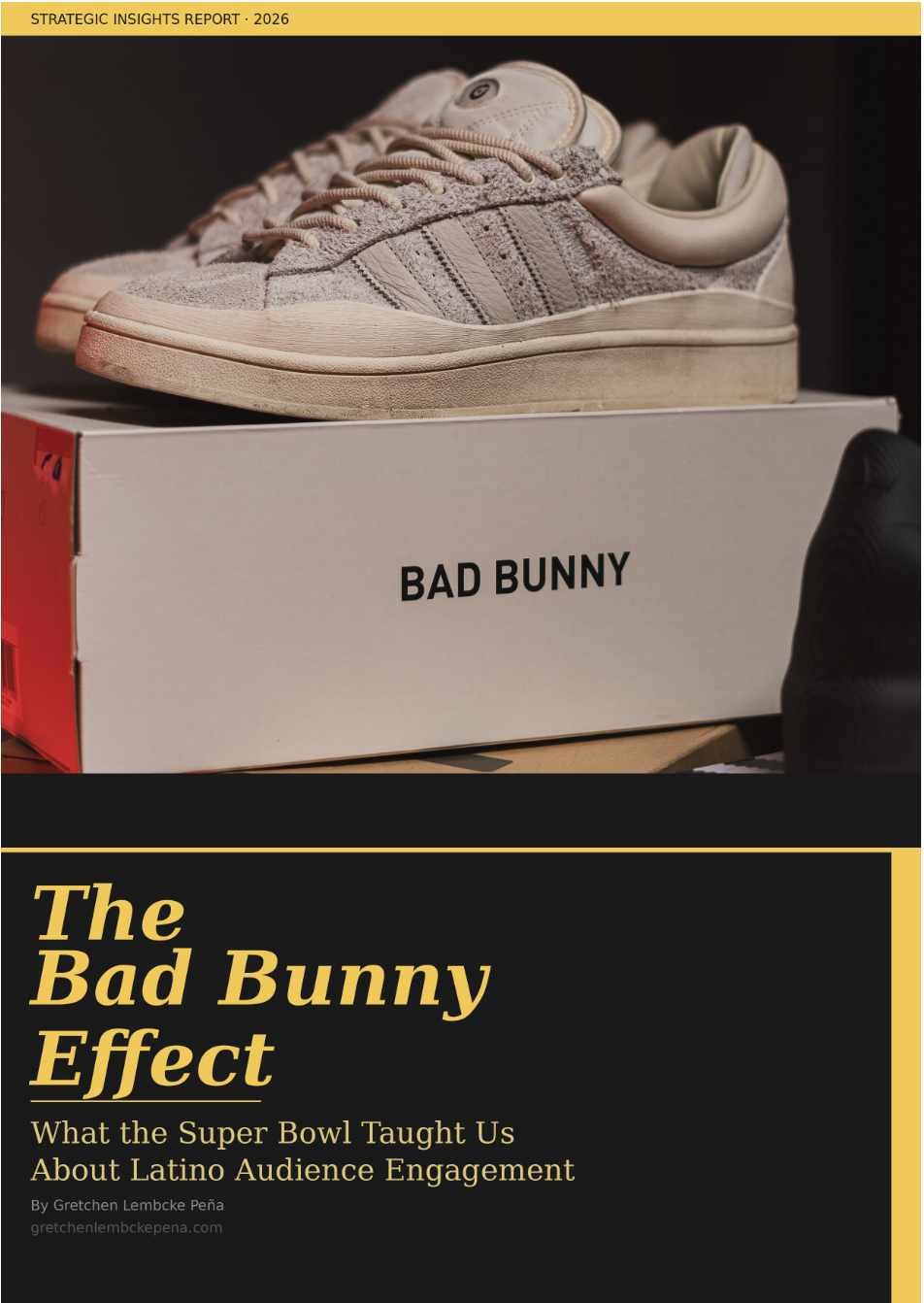
The Bad Bunny Effect: What the Super Bowl Taught Us About Latino Audience Engagement
Executive Summary
Bad Bunny's 2026 Super Bowl halftime show became the most-watched Spanish-language performance in NFL history. While his overall viewership of 128.2 million was slightly lower than the previous year's record, Spanish-language broadcast viewership reached an all-time high of 3.3 million [7]. The data reveals a clear pattern: representation drives engagement. When brands and platforms authentically reflect the audiences they want to reach, those audiences respond at scale. For brands targeting Latino consumers, the lesson is simple — genuine cultural understanding, not surface-level outreach, is what builds lasting connection.
Cultural Context
Bad Bunny is a Puerto Rican rapper, singer-songwriter and record producer primarily known for his Latin trap and reggaeton music. He began his career in 2016, rising to fame internationally in 2018 following his feature on Cardi B’s hit song “I Like It”. In the years since, he has become more than a musical artist — he is a cultural symbol of Puerto Rico, its independence movement and its people's resilience.
For Latino audiences, he represents something larger than entertainment. At a moment of heightened political uncertainty around immigration policy, his presence on one of the largest stages in American culture carries weight beyond music. The NFL’s decision to book him as the first artist to perform a Super Bowl half-time show entirely in Spanish was not incidental, but rather a signal to Latino audiences that they were being seen and heard.
The Data
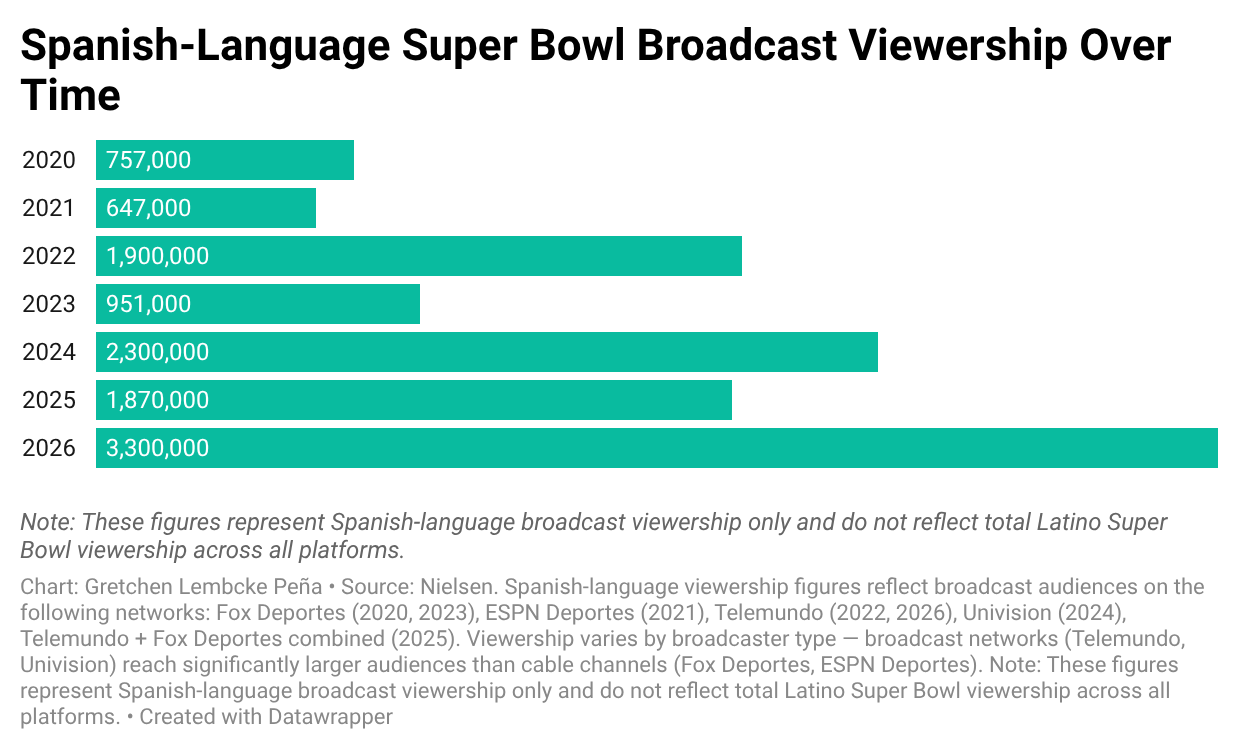
Spanish-language Super Bowl viewership has shifted significantly throughout the 2020s, shaped by both access and audience interest. The pandemic's impact on overall Super Bowl viewership between 2020 and 2023 is reflected in the Spanish-language numbers as well [1][2][4]. Broadcast rights have also shifted between networks each year — alternating between cable outlets like Fox Deportes and ESPN Deportes and broadcast networks like Telemundo and Univision — which has caused viewership to rise and fall independent of audience interest alone.
The clearest example came in 2022, when Telemundo became the first broadcast network to carry the Super Bowl in Spanish, expanding access to Hispanic households nationwide and removing the cable subscription barrier that had limited reach for years [3]. By 2026, when Telemundo once again held exclusive rights and paired the broadcast with Bad Bunny's historic performance, Spanish-language viewership reached an all-time high of 3.3 million [7].
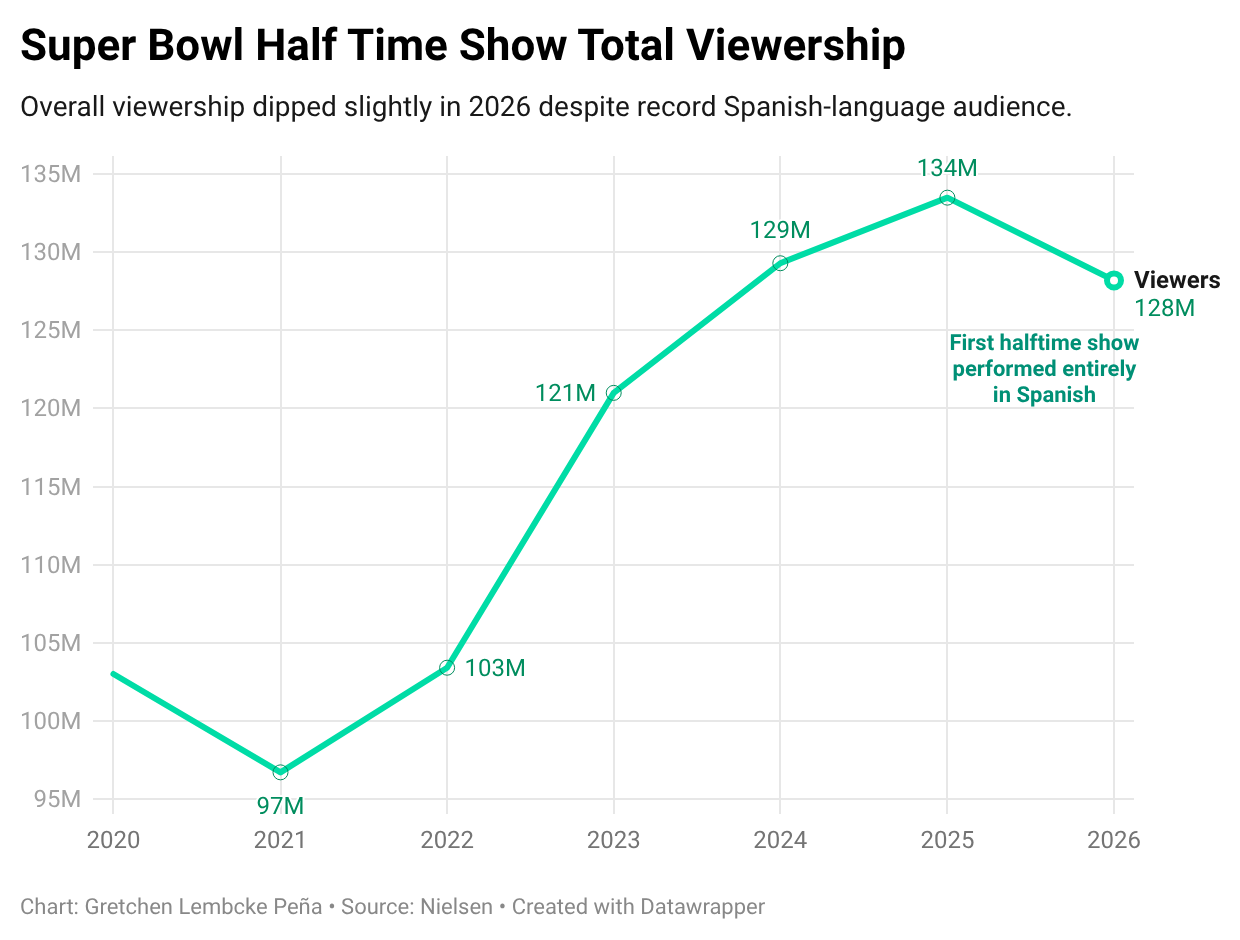
Total Super Bowl halftime viewership has fluctuated significantly over the past six years. Between 2020 and 2021, viewership dropped sharply as the COVID-19 pandemic restricted in-person gatherings and disrupted advertising. The Weeknd's 2021 performance drew just 97 million viewers, the lowest halftime audience since 2007 [2]. Viewership has climbed steadily since, peaking at 134 million during Kendrick Lamar's 2025 performance, becoming the most-watched halftime show in Super Bowl history[6]. In 2026, total viewership dipped slightly to 128 million [7]. But this modest decline tells only part of the story. While the general audience numbers dipped slightly, the Spanish-language audience reached a historic high, proving that Bad Bunny’s performance didn’t just maintain the Super Bowl’s mainstream appeal, but expanded who was watching.
Analysis
Historically, brands across the country have under-invested in Latino audiences due to three main factors: a “total market” approach that overlooks cultural nuance, a lack of Hispanic decision-makers in agency and corporate leadership and an over-reliance on surface-level stereotypes rather than authentic engagement. Advertisers tend to assume a single English-language campaign would successfully reach all demographics, failing to account for the diverse, bilingual and bicultural realities of Latinos in the U.S. This contributes to surface-level nods or campaigns during holidays like Hispanic Heritage Month, leading to a public perception of brands engaging with Latino audiences performatively rather than genuinely.
Omnicom Media Group’s research confirms this pattern[[8][9]. In a 2024 report, the agency noted that despite the cultural explosion of the 1999 “Latin Boom”, Hispanic ad spend grew from 1.5% to 3% of total advertising budgets. A quarter century later, it has only reached 4% [8]. The NFL booking Bad Bunny is an example of what authentic engagement can achieve — and the data proves it. It represents the opportunity the industry missed in 1999: a clear signal of Latino audience engagement that brands have historically failed to translate into proportional investment.
Strategic Recommendations
Build anticipation before the moment, not just awareness during it.
Brands that capitalized most effectively on Bad Bunny's Super Bowl performance began their activations well before kickoff. Apple Music released a teaser clip starring Bad Bunny, which amassed 3 million likes in 7 hours, quickly crossing 5 million likes in under a week, and peaking around 8.7 million likes, becoming its most-liked artist teaser Instagram post in history [13]. Duolingo launched a "Say It in Spanish" campaign that tapped directly into the cultural buzz surrounding his performance, offering users a promotional code for Spanish lessons — more than 60% of the users who redeemed that code remained actively learning on the app leading up to the big game [14]. Both examples prove that the brands who win during a cultural moment are the ones already joining the anticipation rather than the ones scrambling to respond once it's happening.
Real-time wins are earned in advance
Real-time impact during the performance was only possible because of relationships built well in advance. Adidas, who has partnered with Bad Bunny since 2021, had him debut a new colorway of his BadBo 1.0 sneaker live during the show, generating 1.6 million in Media Impact Value and a 496% spike in global Google searches for the shoe just hours after the performance [10][12]. Zara, dressing him for the performance, generated $3.1 million in Media Impact Value through a similar long-term styling relationship [11][12]. Their visibility during the moment was the payoff of groundwork laid months or years earlier.
The engagement window closes within days, not weeks
The brands that captured the most value after Bad Bunny's performance were the ones with a plan ready to execute within hours. Adidas’s surprise-release of the new BadBo 1.0 colorway the Monday following the Super Bowl, captured global search interest at its 496% peak before it had time to fade [10][12]. Bad Bunny's music saw a rise in listeners, with songs like 'Tití Me Preguntó' reaching 5.4 million streams in the days immediately following the show [15]. The lesson for brands is clear: the window to capitalize on a cultural moment closes within days, not weeks. Without a pre-built plan to launch, restock or release content immediately after the moment, even the most successful real-time activation loses most of its value.
Move beyond single moments toward sustained cultural investment
The brands that benefit from moments like Bad Bunny's Super Bowl performance are not the ones chasing a single viral moment, but rather the ones who treat it as confirmation of a much larger, ongoing opportunity. This requires brands to conduct deep, continuous research into what Latino audiences actually value, how they engage on social media and what authentic representation looks like beyond surface-level assumptions. Authenticity cannot be manufactured through cookie-cutter campaigns built on what brands assume Latino consumers want; it requires listening and adaptation. The difference between a brand that treats this moment as a one-time opportunity and one that treats it as a long-term commitment comes down to a single question: are they building an audience, or simply borrowing one temporarily?
Key Takeaways
Cultural representation helps expand mainstream appeal. Bad Bunny being the first performance entirely in Spanish garnered 3.3M Spanish-language viewers— an all-time record — while overall viewership remained among the highest in Super Bowl history [6][7].
Real-time impact is earned through advance relationships, not improvisation. Adidas featuring BadBo 1.0 garnered $1.6 million in MIV; Zara styling Bad Bunny helped the brand reach $3.1 million in MIV [10][11][12].
The cultural moment benefited Bad Bunny as much as the brands around him. His song "Tití Me Preguntó" surged to 5.4 million streams in the days following the performance [15], proving that authentic representation creates value for every party involved
The lesson for brands extends far beyond one Super Bowl performance: it’s about showing up authentically and understanding your audience at their core.
Sources
[1] Nielsen — Super Bowl LIV Draws Nearly 100 Million TV Viewers, 44 Million Social Media Interactions (2020)https://www.nielsen.com/news-center/2020/super-bowl-liv-draws-nearly-100-million-tv-viewers-44-million-social-media-interactions/
[2] Nielsen — Super Bowl LV Draws Nearly 92 Million TV Viewers (2021) https://www.nielsen.com/news-center/2021/super-bowl-lv-draws-nearly-92-million-tv-viewers/
[3] Nielsen — Super Bowl LVI Draws More Than 101 Million TV Viewers (2022)https://www.nielsen.com/news-center/2022/super-bowl-lvi-draws-more-than-101-million-tv-viewers/
[4] Nielsen — Super Bowl LVII Totals More Than 113 Million Viewers, Ranks Second Most-Watched Game Ever (2023)https://www.nielsen.com/news-center/2023/super-bowl-lvii-totals-more-than-113-million-viewers-ranks-second-most-watched-game-ever/
[5] Nielsen — Super Bowl LVIII Draws 123.7 Million Average Viewers, Largest TV Audience on Record (2024)https://www.nielsen.com/news-center/2024/super-bowl-lviii-draws-123-7-million-average-viewers-largest-tv-audience-on-record/
[6] Nielsen — Super Bowl LIX Makes TV History With Over 127 Million Viewers (2025)https://www.nielsen.com/news-center/2025/super-bowl-lix-makes-tv-history-with-over-127-million-viewers/
[7] Nielsen — Super Bowl LX Delivers 125.6 Million Viewers (2026) https://www.nielsen.com/news-center/2026/super-bowl-lx-2026/
[8] Omnicom Media Transform — Advertisers Are Still Significantly Under-Investing in the Hispanic Audience, Despite "Latin Boom"https://transform.omnicommedia.com/advertisers-are-still-significantly-under-investing-in-the-hispanic-audience-despite-latin-boom/
[9] HACE — Michael Roca, Omnicom Media Group Cross-Cultural Center of Excellence https://haceonline.org/michael-roca/
[10] WWD — Bad Bunny's Super Bowl Halftime Show Sneakers Generate $1.6 Million in Media Exposure for Adidashttps://wwd.com/footwear-news/shoe-trends/bad-bunny-super-bowl-adidas-media-impact-value-1238555975/
[11] Adweek — Zara and Adidas Share the Stage at Bad Bunny's Super Bowl Halftime Showhttps://www.adweek.com/brand-marketing/zara-and-adidas-share-the-stage-at-bad-bunnys-super-bowl-halftime-show/
[12] HIGHXTAR — Bad Bunny and Zara: The Most Talked-About Look of Super Bowl 2026 https://highxtar.com/en/bad-bunny-and-zara-the-most-talked-about-look-of-super-bowl-2026/
[13] Complex — Bad Bunny Breaks Record for Most-Liked Super Bowl Teaser https://www.complex.com/music/a/antonio-johri/bad-bunny-most-liked-super-bowl-teaser
[14] Brand Innovators — Duolingo Offers to Help with Bad Bunny Translation https://brand-innovators.com/duolingo-offers-to-help-with-bad-bunny-translation/
[15] ABC News / Associated Press — Bad Bunny Streams Skyrocketed After the Super Bowl, Up 175% in the U.S. https://abcnews.com/Entertainment/wireStory/bad-bunny-streams-skyrocketed-after-super-bowl-175-130064070